14 Dec 2017

1 Dec 2017
Research launch and seminar: The Productive Office

The first part of the seminar focused specifically on workplace design and the research findings were presented by Adam Mactavish of Currie & Brown who lead the BCO’s latest work ‘Defining and measuring productivity in offices’. Adam shared valuable
insights on the work they have been carrying out over the last four months with
special thanks to Ramidus Consulting and Despina Katsikakis
who added valuable industry experience looking at the influence of the
workplace itself on productivity with examples. A series of interviews and
workshops took place with people in the supply chain. Productivity seems to be
the buzz word at the moment and is either the source of all scepticism or the
source of all opportunity depending on your perspective.
Adam spoke about some of the lower hanging
fruit that makes a valuable contribution to productivity, that which is readily
available to us now, and opportunities that we are already aware of as property
professionals improving productivity in UK offices. Adam questioned
whether we were doing it as widely and routinely across the UK as we could.
Those involved in corporate real estate are often more focused on the cost of
property rather than the opportunity the property presents to them.
Adam began by addressing the definition of
productivity in offices and how we can go about measuring and improving it.
The report hopes to encourage industry professionals to occupy more productive
workplaces or to improve the workplaces they are currently in. There was a
deliberate attempt not to replicate the tremendous amount of research on
productivity already out there. The study instead provides a framework that people can
use when discussing productivity so as an industry we are consistent in our approach.
The report covers the influence of the
workplace on productivity and stresses that although the office itself is important, it is only
one of several dimensions. There are short sections on the value of
productivity, recognising productivity and measurement of productivity in
the workplace. Starting with the influence of the workplace, the report looks
at the office as a tool to deliver change within an organization, to help
embody the company culture, provide facilities and at its heart provide the
opportunity for people to be able to do their work well. As ever, it’s also
about attracting and retaining the best people. The report covers the many
factors which influence engagement with the workplace. There are many buildings
toured at every BCO conference and there have been examples of companies trying
to adopt agile working practices while not having sufficient WiFi to enable
people to move from place to place and connect properly. Kate Vine of Perkins +
Will brought this up later in the panel discussion- ‘We love to design
beautiful spaces, but also - the technology has to work and the environment has
to be healthy for the office to be productive’.
Session 2 of the seminar was dedicated to
the impact of environmental qualities on productivity. In this section LCMB together with their
Consortium Partners (including the BCO) outlined their interim findings on WLP+
(The Whole Life Performance) project, funded by Innovate UK. The project seeks to empirically validate the link
between indoor environmental conditions and staff utilisation, output and
absenteeism, by demonstrating the solution in three commercial case study buildings
where there is available data on staff productivity.
Managing Director of LCMB, John O’Brian, kicked off the introduction to WLP+ saying that productivity in the UK has flat-lined since 2008. The industrial partners included Argent, Kings College London, EMCOR UK, Constructing Excellence, and
the academic lead Rajat Gupta of Oxford Brooks University. Members were shown
the results we are starting to see and Rajat presented some early findings and
insights around office air quality and the impact this has on productivity. For the last
17 years they have studied over 200 buildings and concluded that when occupants
are satisfied with their indoor environment, productivity levels increase.
Steve Dolan, Senior Account Director, EMCOR
UK presented the first case study which covered the NATS analysis and the
correlation between facilities management and productivity. EMCOR UK is the FM
provider for NATS, one of the trial sites for the study. A second case
study followed from Nick O’Donnell, Director of Estates & Facilities, King’s
College London. Nick went over how a drop in oxygen in their office directly
affected staff performance and while basic, an improvement in morale and
productivity was seen once there was an increase in oxygen levels. Lastly Peter
Runacres, Senior Projects Director from Argent presented a third case study
before the panel closed with a Q&A. Peter made mention of the levels of CO2
being extraordinarily high in meeting rooms where staff should be most
productive, for example in a board meeting.
WLP+ is a benchmark approach. It aims for the tested solution to then be developed into a software-based supervisory
control and reporting solution operating in a cloud environment, with the
capability to reset the controlled environment to maximise occupant productivity and comfort conditions, whilst minimising energy and fuel use and costs in
commercial office environments. Learn more about how the WLP+ project is
progressing: https://www.wlpplus.com/project-overview/
-Follow the conversation on Twitter .
-Photo by Timothy Soar
8 Nov 2017
Top Tips From the Judges for entering The BCO Awards 2018

We have asked the Judging Chairs, what advice they would give someone planning to submit an entry for the 2018 Awards. Here are their answers:
Nigel Clark, Hilson Moran - National Judging Chair
Nigel's top tip: "Set out your entry clearly and concisely and use the questions in the entry guide to explain to the judges what sets your project apart from other entries. Focus not just on the building, but also on the impact and change the project has delivered."
Ian Aldous, Arcadis - Northern Judging Chair
Ian's top tip: "The awards are about recognising excellence in the workplace, and one specific area of focus should be the impact it has - on the people that work there, the businesses that operate from there and the local community that surrounds it."
Alistair Allison, Tuffin Ferraby Taylor - South of England & South Wales Judging Chair
Alistair's top tip: "A successful office development needs a clear brief and it is important for this to be explained to the judges and to show how the design, construction and commercial solutions have been tailored to suit this. Also, highlight areas of the project that stand out."
David Dool, Cooper Cromar - Scottish Judging Chair
David's top tip: "As the BCO Awards are the benchmark for defining excellence in the workplace, submissions should, in addition to answering the 'Judges Questions', convey what sets the project apart in terms of its speciality and appeal to occupiers. A strong, factual and passionate submission generally reflects the excellence of the project and sets the scene for shortlisting and the judges' visits."
Nick Searl, Argent - London Judging Chair
Nick's top tip: "Make sure that your submission allows the judges to see what makes your building or fit out unique and special. Be proud of what you've done, show us the passion that went into making it and let your answers demonstrate why you think it's a winner."
Rob Van Zyl, Cundall - Midlands & Central England Judging Chair
Rob's top tip: "Always answer all the questions, even if you feel your submission is weak in one area. The judges award points for every question. For example, if your building only achieved a moderate EPC score, still state what it achieved rather than avoiding the question. Better to get a few points than none in weak areas."
To enter your project for the awards simply register on our entry website www.bcoawards.co.uk and create an entry. Entries are submitted online in three easy stages:
1. Enter project details
2. Answer the 'Judges Questions' as outlined in the entry guide
3. Upload 10 images and submit
19 Oct 2017
Office Service Standards and Customer Experience: A best practice guide

It’s just 2 years since BCO published its ground-breaking report Building Performance – Rethinking the Relationship between Owners, Managers and Occupiers. The report set out a 10-point action plan to improve stakeholder relations and remove much of the friction that frustrates corporate occupiers. “Office Service Standards and Customer Experience: a best practice guide” highlights the revolution currently occurring in the property industry’s approach to delivering service, based on customers’ requirements ‘from space as a commodity’ to ‘space as service’. It also forms the basis for a consultation with the BCO members on the format of a new BCO Customer Experience Award which will recognise those owners and their managers that are running buildings in a truly innovative and customer focused way.
The research identified the need for change and articulates benefits for both owners and occupiers in adapting a new and inclusive approach that is more engaging and in line with a customer service and satisfaction ethos across other industries. Office owners, managers and occupiers were engaged with to define and communicate what the industry should be delivering by way of effective and efficient building services that match a significant improvement in building and workplace design and quality in recent years.
We participated in the debate and discussion at the breakfast seminar held on the 17th October at UBS, Broadgate, London sponsored by British Land, LGIM Real Assets, CBRE and Broadgate Estates. The panel was joined by Polly Plunket (Property Management Director, Broadgate Estates) Debbie Hobbs (Head of Sustainability, LGIM Real Assets) Danny Harte (Senior Director, CBRE) and Gary Wingrove (Projects and Construction Director, BT Facilities Services).
As recent PhD research by Dr Danielle Sanderson shows, there is a clear commercial case for investing in building strong relationships with occupiers. I am excited that there is evidence that our attention is now shifting from a viewpoint of ‘What’s wrong with the way we do things?’ to ‘How we can make things better for our occupier customers?’ That’s why this latest report is designed to provide those forward-thinking property owners and managers who want to change their approach with practical guidance in the form of checklists, scorecards and case studies. These will measure how well an office building is performing, viewed from the perspective of the owner, property manager and occupier.
The checklists, designed to help property owners, managers and occupiers understand what best practice looks like, follow the broad structure of the RealService ‘Best Practice Framework’ and cover the following areas: customer experience culture, customer insight and service design, collaboration with service partners, leadership & training, operational excellence, and, performance measurement.
There has never been a more apt time for our industry to get close to our customers – the price to pay for missing this opportunity is potentially great. Who could have predicted the seismic shifts in the political, economic, social and technical worlds that we have seen over the past 18 months? If ever there was a time to stick close to your customers it’s now!
Other industries have learned the hard way that failure to innovate and to follow the customer is a sure-fire way to attract the attention of the business disruptors – like Uber, eBay, Amazon, Airbnb, etc. The office industry is seeing new entrant disruptors like WeWork and The Office Group transform the experience of the workplace.
-Chris Richmond, PwC Chair, BCO Occupier Group
For more information on Office Service Standards and Customer Experience or to download the report, access the BCO research page.
13 Oct 2017
Plotting The Future

“In the age before
computers, architects were regularly in trouble for getting their hand-drawn
perspectives completely wrong.” The BCO’s Urban Group held an interesting
debate at U+I’s offices on the future effect that technology may have on the
way we plan the development of our cities. We discussed the benefits and
constraints of ‘Computerised London’ following presentations on new technology
and 3D Models.
As the sophistication of technology improves, our
interaction with the world around us becomes more natural and
comfortable. With computerised tools, the emphasis is very much on the
visual, with every step in the process clearly illustrated. The basic tutorials
cover the essentials of tools and then move on to a discussion of components
which are vital if you are to use them efficiently.
Vu.City, creators of highly accurate, fully interactive 3D
digital city models, gave the audience a preview of their London mapping
software, demonstrating the immediate benefits to the property profession of an
instant and current 3D model of our capital. The ability to place yourself
anywhere in or over London and assess the past, current and future built environment
from your laptop is powerful in itself. There is then endless potential to add
programmes and information to analyse and test site potential accurately and
quickly.
In the property industry this could help Planners and
Politicians assess and inform policy, while reducing the burden on every
developer to reproduce information time and time again for planning
applications and site assessments. Add real time data from the network of
cameras and receptors around our city and there is a real time model of London
that could be useful to other professions and businesses. Peter Barbalov, Architect
and Design Partner at Farrells, outlined the evolution of urban design and
articulated the importance of man working with machine, using technology to
optimise decision making and test creativity.
Peter Wynne Rees CBE, Professor of Places & City
Planning, UCL Faculty of the Built Environment was charged with
challenging the advance of technology and he warned of the dangers of losing
human touch and personal authenticity. Questions over the control of the
technology and the accountability for accuracy were raised. However, Peter
conceded that if such a tool could help the ‘developer’ work with the Planners
at an earlier stage in the design development process, and there was greater
clarity over planning guidance and decision making, then this would be a
welcomed initiative.
Questions were raised about ownership of such a powerful
model, and the responsibility and accountability for authentication of outputs.
This is a topic that will run its course but anything that increases
efficiency in the planning process and helps with the interpretation of policy
will reduce development cost and help make UK PLC more competitive.
The 3D model gives us a whole new perspective on buildings.
We can check the interior layout, model sunlight at various times of the day,
and get an estimate of the outdoor area. Instructing architects and the
builders is likely to become easier than ever before. If a picture is worth a
thousand words, what difference can an interactive 3D model make?
-Duncan Trench, BCO Chairman of the Urban Group.
For more information on the Urban Group or to view upcoming BCO seminars access the BCO Research page.
11 Oct 2017
BCO Awards 2017 - Celebrating excellence in office space
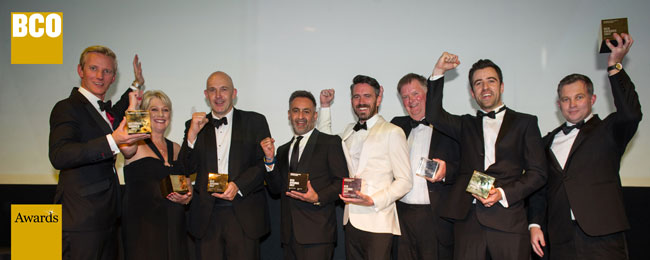
Congratulations again to all of our National
BCO Award winners, who were announced on 3 October in front of almost 1400
of the country's top designers, developers, architects and occupiers:
- ‘Best of the Best’ & Corporate Workplace: Sky Central, Isleworth, Middlesex
- Commercial Workplace: 8 Finsbury Circus, London
- Refurbished/Recycled Workplace: 20 Eastbourne Terrace, London
- Innovation: Sea Containers, London
- Fit Out of Workplace: The Estée Lauder Companies, London
- Projects up to 1,500 sq.m: Concordia Works, Leeds
- Test of Time: Birmingham City Council, Birmingham
‘Best of the Best’ winners Sky Central was praised by
judges for bringing 3,500 of Sky’s workforce under one roof. Judges also
commended the vast array of services and amenities on offer, including six
restaurants and cafes, a 200-seat state of the art cinema, 200-person event
space and a technology ‘lounge’.
Nigel Clark, Chair of the BCO National Judging Panel,
commented: “This year’s winners are a study in how Britain has maintained its
position at the forefront of the global office sector. Each building is both
adaptable and robust, providing occupiers with the flexibility they need to
ensure the wellbeing and productivity of their workforce. Sky Central, the Best
of the Best award winner, is a prime example. The building provides ample
amenities to Sky’s large workforce, whilst ensuring a productive environment by
breaking the larger space down into distinct workplace neighbourhoods.”
Richard Kauntze, Chief Executive of the BCO,
commented: “This year’s awards nominees have impressed across the board
with their commitment to sustainable and innovative design. London has played
host to a record number of award winners this year, affirming why businesses
from across the world come to the capital. Congratulations to all nominees, our
highly commended entrants and, of course, the award winners themselves.”
Read some of the tweets here or head to our photo gallery for a visual recap of this wonderful evening.
Entries for 2018’s BCO Regional and National Awards
programme opened on Wednesday 4 October 2017; the closing deadline is: Friday
24 November 2017.
10 Oct 2017
World Mental Health Day 2017

The BCO recognises the importance of the growing Health & Wellbeing agenda, which we would term a paradigm shift, and the implications it has for office design and how the attitudes towards the office are changing. Furthermore, we recognise that the rapid escalation of literature, views and certification has led to confusion over “what really matters”.
Since last year’s World Mental Health Day, the national conversation on mental health has gained significant momentum. In the past year Mental Health First Aid England (MHFA) England has trained a further 65,000 people in Mental Health First Aid. As a result, to date over 206,000 people in England have Mental Health First Aid skills. Just some of the employers who have taken ownership of mental health in their workplace and trained Mental Health First Aiders include Unilever, Siemens and WHSmith. Designers, developers, researchers, and management teams all have a critical role to play in ensuring that healthy work environments become a standard in office culture.
In April The British Council for Offices (BCO) announced the commissioning of a major research study “Wellness Matters: Health and Wellbeing in offices and what to do about it”. The year-long project will provide definitive guidance on how to enable office Health and Wellbeing across a building’s lifecycle.
The study will critique existing Health and Wellbeing measurement and certification, identify the most recent and relevant medical evidence justifying a proactive approach to Health and Wellbeing in the built environment, and give guidance on the business case for investment in this space beyond simply improving productivity. Most significantly, this research will deliver a practical guide to creating a healthy environment across the different stages of a building’s life cycle, from design, construction and leasing to the most important aspect by time and value: occupation and asset management.
The project, which will culminate in the publication of a report in March 2018, will be led by a consortium comprising architecture and design firm Perkins+Will, sustainability consultancy Sentinel RPI and Elementa Consulting, backed by medical and academic input from Royal Brompton, Imperial College and Queen Mary University. The findings will also inform the next BCO Guide to Specification, which is the industry-recognised standard for best practice in office development across the UK, also due to be published in 2018.
Access the BCO research page and download reports to find out more about wellness in the workplace. Become a member, join the debate and help to shape the future of the industry
Subscribe to:
Posts (Atom)