Showing posts with label offices. Show all posts

11 Oct 2017

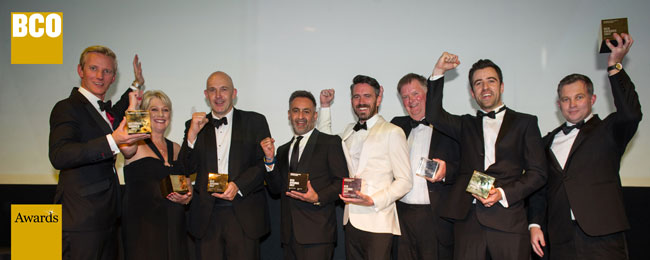
BCO Awards 2017 - Celebrating excellence in office space


Congratulations again to all of our National BCO Award winners, who were announced on 3 October in front of almost 1400 of the country's top designers, developers, architects and occupiers:

  • ‘Best of the Best’ & Corporate Workplace: Sky Central, Isleworth, Middlesex
  • Commercial Workplace: 8 Finsbury Circus, London
  • Refurbished/Recycled Workplace: 20 Eastbourne Terrace, London
  • Innovation: Sea Containers, London
  • Fit Out of Workplace: The Estée Lauder Companies, London
  • Projects up to 1,500 sq.m: Concordia Works, Leeds
  • Test of Time: Birmingham City Council, Birmingham


‘Best of the Best’ winners Sky Central was praised by judges for bringing 3,500 of Sky’s workforce under one roof. Judges also commended the vast array of services and amenities on offer, including six restaurants and cafes, a 200-seat state of the art cinema, 200-person event space and a technology ‘lounge’.

Nigel Clark, Chair of the BCO National Judging Panel, commented: “This year’s winners are a study in how Britain has maintained its position at the forefront of the global office sector. Each building is both adaptable and robust, providing occupiers with the flexibility they need to ensure the wellbeing and productivity of their workforce. Sky Central, the Best of the Best award winner, is a prime example.  The building provides ample amenities to Sky’s large workforce, whilst ensuring a productive environment by breaking the larger space down into distinct workplace neighbourhoods.”

Richard Kauntze, Chief Executive of the BCO, commented: “This year’s awards nominees have impressed across the board with their commitment to sustainable and innovative design. London has played host to a record number of award winners this year, affirming why businesses from across the world come to the capital. Congratulations to all nominees, our highly commended entrants and, of course, the award winners themselves.”

Read some of the tweets here or head to our photo gallery for a visual recap of this wonderful evening.

Entries for 2018’s BCO Regional and National Awards programme opened on Wednesday 4 October 2017; the closing deadline is: Friday 24 November 2017.

25 Sept 2017

What Workers Want


Without income property has little value. It is surprising, therefore, that the industry spends an awful lot of time looking at design, construction and investment, but relatively little on occupation.


What Workers Want has been published by the BCO and Savills twice, in 2013 and 2016. The latest research draws on a survey of more than 1,100 office workers conducted by YouGov. We have found it gives insights you wouldn’t normally get from asking the workers’ representatives at C-suite level. Who’d have thought that smell was so important?

The factors deemed by over 70% to be highly important were: the length of commute; cleanliness; toilet provision; wifi; private space for focussed work and public transport.  Meanwhile, factors affecting wellbeing specifically were comfort; temperature; light; noise; smell and security.

The study also measured the gap between importance and satisfaction. Areas for improvement included the provision of quiet space; wifi; cleanliness and internal design. Perceived productivity in open plan versus private office was also tested, with the (expected?) view that open plan decreases productivity.

We can draw the following inferences:
  • There is some disconnect between what workers actually want and what their employers say they want (or maybe just what the office supply industry thinks they want).
  • The simple things are important and can be provided easily by facilities management (cleanliness) and specification (toilet provision).
  • An engaging façade is nice to have, but makes little difference to occupant satisfaction and, therefore, recruitment and retention. Attention is better spent on:
  • Enabling productivity. This is a subject of a whole new workstream but what is evident is that workers value the ability to work in a focussed way but are frustrated by the lack of provision. 

This is not the same as saying “open plan is dead”. There will be no return to private offices and cubicles, but there is no good reason why optionality cannot be provided.

"While wellness has, in some quarters, become the property industry buzzword for 2017, this is one of the most visible examples we have seen in practice and it certainly won’t be the last. Developers are increasingly including these innovative features at design stage, creating the first wave of ‘well buildings’ across the country. This phenomenon is not unique to the office sector; the industrial market is also starting to understand the benefits of putting staff first." -Property Week

-Author: Bill Page, Chairman of the BCO Research Committee.
-For more on 'What workers want' download the full report here.
-Access the BCO research page and download reports. Become a member, join the debate and help to shape the future of the industry

16 Nov 2016

3 top tips from the BCO Awards Judging Chairs


We have asked some of the Judging Chairs, what advice they would give someone planning to submit an entry for the 2017 Awards. Here are their answers:


Nigel Clark (National Judging Chair): "When you answer the 'Judges Questions', make sure you emphasise every noteworthy credential in your submission. Also: focus on people, not buildings and bear in mind that shortlisting may have to be done on the strength of your submission, so make sure it stands out."
Stephen Lewis (Scottish Judging Chair): "The occupier as end user of offices is key, so the submission should highlight how the project meets their needs, whether it's speculative (commercial) or let (corporate)."
Matt Viall (Midlands & Central England Judging Chair): "It's always great when you see a submission that clearly demonstrates the passion for the project. We look for entries that show that the project team set the bar high from the outset and challenged the 'norms'.  And: always include the numbers and check the maths... we do!"
HOW TO ENTER YOUR PROJECT  
To enter your project for the awards  simply register on our entry website www.bcoawards.co.uk and create an entry. Entries are submitted online in three easy stages:
1. Enter project details
2. Answer the 'Judges Questions' as outlined in the entry guide
3. Upload 10 images and submit

8 Apr 2013

60 seconds with...Helen Hare (GPE) and Bill Price (WSP) talking tours at the BCO Annual Conference 2013


From Wednesday 15 to Friday 17, we will be hosting the BCO Annual Conference in Madrid. The topic for this year is "A Brave New World" with the aim to explore how recent financial challenges are being dealt with by local developers, designers, banks and office occupiers.

Alongside our programme of plenaries and seminars, focussing on key topics relevant to the industry today, we have a varied programme of tours featuring stunning contemporary and classical architecture.

To find out a bit more of what's on offer in Madrid 2013, we spend 60 seconds the people behind our tour programme - Helen Hare,  Project Manager at Great Portland Estates, and Bill Price, Director at WSPUK.

How long have you been working on the tour programme for the BCO Annual Conference 2013? 
Work started in the Spring of 2012 with an arduous initial couple of days spent in the sophisticated city of Madrid. This was followed by three further visits in the autumn of 2012. 

Did you have any opinions on property development in Spain before you first visited? 
I was aware of their recent problems in the property sector, but unprepared for the strong sustainability and cost in use provisions. 

Were you surprised by what’s on offer? 
Yes, the quality and scale of many of the office projects is stunning. These are a major offer for BCO delegates.

What would you say the Madrid market does best? 
The global campus style HQ with excellent facilities and strong ideas about connectivity. Both Santander's HQ , in Boadilla del Monte, is a good example for people to take a look around.

How would you sum up the tour offering at this year’s conference? 
Excellent variety of brand new, established and classic buildings. Delegates are going to enjoy and learn from the visits. 

Do you have any personal highlight? 
(Bill Price) Repsol HQ is a symphony in putting the structure outside the building envelope to create adaptable interiors. BBVA new HQ is likely to be a hidden gem, truly a different kind of HQ building. 

(Helen Hare) From the moment you arrive you enter the amazing Barajas airport and Telefonica has a great public realm offer. 

What do you think delegates will get out of visiting projects in the Spanish capital? 
Delegates will see interesting examples of addressing a continental climate. Cold winters and hot summers are a glimpse into what the UK might be heading towards. Shading, screening, glazing, facades, colours, landscaping and use of public realm are frequently impressive. 

On your visits, have you had a chance to sample the social side of Madrid? Do you have any recommendations? 
There is an awful lot to do in Madrid outside the main BCO conference programme. If you're planning to stay the weekend following then we'd certainly recommend checking out:

  • Restaurants: top end restaurants are very impressive. Zalacain and Pan de Lujo are exceptional. 
  • The three key art galleries: Prado, Thyssen and Reina Sofia are fantastic. 
  • Parks and gardens are beautifully maintained along with the top public buildings. 
  • Tea at the Ritz close to the Prado is a treat as are the many more modest bars and cafes around the Plaza Mayor in the old town. 

If you were to share one top tip with our conference delegates what would it be? 
A few top tips include: 

  • To try to make sure your taxi driver really knows where you want to go, trust but verify. 
  • Ask a local to order the wine. They choose top quality Rioja at worryingly reasonable prices. 
  • Do explore on foot, the distances are manageable and its’ great to be ‘on the street’. 
  • Book your restaurant in advance. Despite the rumours about Madrid being in dire financial straits, getting a table at a good restaurant is not achievable on spec. 
  • Be prepared to eat supper later in the day, the Spanish start their evenings at 9pm
Places are still available at this year's conference but we would encourage you to book soon to ensure your preferred tour choice.

For more information and how to book please visit www.bco.org.uk/conference

We look forward to seeing you in Madrid soon...

8 Jan 2013

60 seconds with...Richard Kauntze, Chief Executive of the BCO

It's the start of a new year, so who better to spend 60 seconds with than our very own Chief Executive, Richard Kauntze.

Richard has led the BCO since 1999 and has seen it grow from an organisation with 500 members to 1,500 as it is at present. The last few years have been tough for the industry as a whole, find out whether Richard believes the year ahead will be more promising.

What will the British Council for Offices (BCO) be looking forward to in 2013? 
A great deal! We kick off, of course, with the Annual Dinner (22 January), traditionally the start of the property world’s New Year. Early Spring sees the now well established regional awards lunches and dinners, while between 15-17 May the BCO goes to Madrid for its Annual Conference. Madrid 2013 promises to be outstanding. 

What was your highlight of 2012? 
Winning tickets for the women’s beach volleyball at the 2012 Olympics! (hugely entertaining, if a little surreal in the middle of Horse Guards Parade). Slightly more seriously, also winning tickets for the athletics, and the opening day at that! Just reward for having completed an ‘O’ Level in Olympic ticket applications (which is what it felt like navigating the website). 

What do you see as the main challenge for the industry over the next 12 months? 
The uncertainty of the economic recovery (will we avoid a triple-dip recession?) will unquestionably remain the backdrop to everything else. My gut feeling is that we will start to see some modest growth this year and next, but the recovery will be slow and the road a long one. Occupiers understandably remain very cautious. 

What do you see as the main challenge for the BCO over the next 12 months? 
Delivering the best service possible to our members with the resources available to us is our constant challenge. 

If you had the power to change one thing within the property industry, what would it be? 
Tricky, but somehow to secure far broader recognition for the vast array of talented individuals and companies which make up the office sector. Our best buildings are among the best, sometimes the very best, in the world. The architect’s name may be cited. Few others get a look in, and yet they are all the products of a very broad spectrum of talent, reflected in the BCO’s membership. 

Who, or what, has most inspired you in the Commercial Property Sector? 
There have been very many, but if I had to mention one name it would be Ron Spinney. An outstanding talent, who commanded universal respect. 

What’s your favourite office development in the UK? And why? 
Another difficult (and potentially dangerous!) question for a man in my position. Pushed, I would opt for New Street Square in London’s midtown. I love the architecture, always feel uplifted and the development is an absolute credit to all of those involved. 

What couldn’t you live without in your daily routine? 
Coffee in the morning. Addiction might be an understatement. Very much quality over quantity, but a morning without decent coffee is a non-starter.

25 Nov 2012

60 seconds with...BCO's NextGen Chairmen

Matt Flood (left), associate director at DTZ, has chaired the London Committee for nearly one year. Ben Newton (centre), senior associate at Eversheds, and  Paul Norbury (right), director at 5plus architects have taken on the role of Chairman in the Midlands and Northern Region (respectively) in the last six months. 


When did you first get involved in the BCO and what were your initial impressions? 
Paul: I first became aware of the BCO about 8 years ago when I was working on the large RBS fit outs in Manchester. My first involvement was simply attending the technical tours which I suspect is most people’s only experience of the BCO? 

Ben: My first involvement was at the inception of the Midlands NextGen Committee in 2009. It has proved to be an an exciting opportunity for the next generation of leaders in the office sector to share ideas, make contacts and learn from each other – much more than just a networking group. 

Matt: I joined the London committee in 2010 and immediately realised it was a fantastic opportunity to meet a cross-section of the industry at a diverse range of events. 

Can you sum up in three words the benefits of this group? 
Ben: Expanding knowledge and contacts.

Matt: Networking, knowledge and experience. 

Paul: My three words are “interesting”, “talented” and “ideas”...Since I joined the inaugural Northern Committee in 2010 I have spent time with some interesting and talented people on the committee. They always have a broad range of ideas so it’s always good when we meet up. 

Ben & Paul, you have recently stepped up to the role of Chairman in your regions, what do you hope to achieve during your time in post? 
Ben: I want to build on the good work of the Midlands Next Gen Committee to-date and continue to run thought provoking, interesting and well attended events that engage the entirety of the BCO membership in the Midlands (and hopefully expand it). 

Paul: Our targets are to be more active and increase membership. The two go hand in hand though really – there needs to be more activity to convince people to join! Our inaugural year was focussed on establishing ourselves as a committee, running a couple of seminars and working towards the NextGen event at the BCO Conference in Manchester this year. Now we are divulging a little bit and empowering our committee members who are based in Newcastle and Leeds so we spread the efforts and events around the various cities within this region. We have a mini-series of building visits coming up which is looking at industrial buildings that have been reworked into workplaces. We’ve just hosted The Toffee Factory in Newcastle, we will next move to Leeds and then, finally, Manchester. 

Matt, after being in post for over six months, what has been your highlight to date and what are you looking forward to? 
My highlight has to be the NextGen session at the conference in Manchester as it was a combined effort from the NextGen community across the country. Moving forward, I am hoping to successfully establish an initiative between the NextGen and Investor committees. 

What do you all see as a key challenge for the commercial property industry? 
Matt: I would say that the biggest challenge will be sourcing new forms of funding to replace the lack of available debt. 

Ben: Due to the funding difficulties in the sector, developers and landlords need to tailor their product to their customers and offer something different to the market in order to enable them to bring new buildings forward and bring older buildings back in to use. This means they have to work more closely with occupiers to create premises that are more client-focussed, adaptable and economically efficient to operate. 

Paul: I agree and the key challenge will be the creative refurbishment of existing buildings, including creating “office” space out of non-office buildings. Without looking more creatively at building design, the industry will just keep recreating office buildings that have the same old raised floor / carpet / cooling / ceiling solution. Everything will look the same. This isn’t the office of the future, nor does it respond to changing markets and user demands. 

The motto for NextGen is “Learning from the past, looking to the future”, what do you think the key lessons are? 
Paul: The typical market leading offices of the last 15 or so years have served their occupants well, and provided a sound basis for the BCO! There is a lot of good practice we can learn from but we’re interested in the “new directions of office design”. Sustainable, flexible, inspiring and fun work spaces are important, which embrace current trends in technology. 

Who/what has most inspired you in the Commercial Property Sector? 
Matt: John Forrester. 

Ben: Seeing and being involved in the transformation of Birmingham in the 10 years that I have lived in the city. 

Paul: Some of the high profile City of London office buildings are hard to beat, particularly Lloyd’s of London. That building is certainly creative and didn’t replicate the standard office design of the 80’s! 

What couldn’t you live without in your daily routine? 
Ben: My Kindle. 
Paul: iPhone 
Matt: Exercise. 

What is your guilty pleasure? 
Ben: My Norwich City season ticket. Living 160 miles from the ground I don’t get to many games so it’s arguably not great value for money (so my wife says)! 
Matt: Tottenham Hotspur for me. 
Paul: Haribos! We have a “chub cupboard” in the office, which is home to pots of tea and coffee, biscuits, cakes and sweets. The really sour, sugar covered Haribos are a personal favourite!

1 Nov 2012

60 seconds with...Tony Hordon, Director of Business Space at DTZ and BCO Northern Judging Chairman

Tony is Director of Business Space at DTZ and has extensive experience of Agency and Development work, principally providing advice to clients on masterplanning, pre-development design, marketing, property disposal and aquisitions.

He has led the BCO Northern Judging panel since 2011, so we spent 60 seconds quizzing him about his judging experiences to date:

How long have you been a member of the BCO and what do you see as a key benefit? 
I have been a member for some 10 years, during which it has provided an excellent source of information through publications such as The Guide to Specification and the Fit Out Guide, together with of course the various conferences and more recently with my involvement with the BCO Judging Panel. 

You have been on the Northern judging panel for three years and Chairman for one, what has been your favourite moment so far? 
I can honestly say there has been too many moments in order to single out one particular moment. The judging process is incredibly intense over a reasonably short space of time and we pack in so much in terms of the travel, the visits, the debate over the scores and therefore there are many favourite, enjoyable and dare I say entertaining moments! 

What is the hardest part about being a BCO Judge?

Perhaps the most demanding part of being a Judge and certainly a Chairman is the responsibility of arranging the itinerary of visits. The Northern Chapter represents a considerable geographical area to cover from the North of England to Yorkshire to the North West including North Wales and Northern Ireland. Last year for example, we had 23 entrants as far north as Alnwick and as far south as North Wales, together with a visit to Belfast. It is therefore incredibly important to ensure we plan the most efficient route in order to ensure we visit the submission with the appropriate time set aside for each submission. As always best laid plans can be totally thrown when you add the additional ingredients of weather. One particular incident was at Belfast Airport where I had arrived, but unfortunately my fellow Judges, who were flying from Manchester, were kept in a holding pattern for over an hour whilst a significant snow storm blew over! 

What is the best part about being a BCO Judge? 
The opportunity of experiencing a huge variety of schemes across a variety of cities – as part of this variety you get to see the good, the bad and the ugly. Most importantly, firsthand experience of each scheme in terms of the aspiration and ultimately the delivery.   


The Entry Guide asks entrants to describe how the office lifts spirits, is there a past awards entry that made a particularly positive impact on you? And if so, why was this? 
The stand out entry was the scheme we visited in Darlington which was a refurbishment of an old industrial scheme by Marchday and occupied by Student Loans. From the submission the panel were reasonably lukewarm in advance of the visit however on arrival we knew within seconds we were visiting a winner. To convert an old industrial unit into a modern call centre of over 80,000 sq ft with sustainability high on the agenda, air quality, light quality, spacial layout and breakouts was outstanding. It represented perhaps one of the best call centre environments I have ever witnessed – ultimately an environment I would personally work in and certainly a place that as you walk in simply lifts your spirits. 

What advice would you give someone planning to submit an entry for the 2013 Awards? 
As we receive a number of entries, it is important every effort is made to differentiate and highlight the unique points of the project, but in a concise and easy to read manner. I also feel the use of photography is important. 

What one piece of advice would you give to someone starting out as a BCO Judge? 
Get plenty of sleep beforehand, travel with plenty of Nurofen, but be prepared for a wonderful experience from the presentation by the home team, to the actual tour of the submission followed by the debate by the Judging Panel, a debate which is fascinating due to the cross section of the panel. In the Northern Chapter we have five judges on the panel, from five different backgrounds, with an agent, an architect, cost consultant, developer and M&E engineer, therefore five different skills and therefore five different opinions.

Who/what has most inspired you in the Commercial Property Sector? 
Whilst my career has been in office agency and development, I am a somewhat frustrated architect and therefore I guess if there is anything that has inspired me during my career it has been the architectural industry. The vision, the creativity and deliverability that this sector achieves can be game changing and life changing. I have had the pleasure and privilege of working with many architects and it really is a pleasure and an inspiration. 

What couldn’t you live without in your daily routine? 
Blackberry 

What is your guilty pleasure? 
My guilty pleasure would have to be margaritas, although I don't have any guilt, only a headache!

29 Oct 2012

The BCO and Intelligent Buildings

Neil is the Head of Sustainability & Engineering for Land Securities PLC. As chairman of the BCO's Technical Affairs Committee Neil has overseen the production of the latest edition of the Guide to Specification and Guide to Fit Out. 

He is the man behind IntelliBuild (Wednesday 21 November) and we find out more about the conference and what it will cover.

Why have do you feel it’s important to have IntelliBuild, a half day conference on the subject of smart cities and intelligent buildings?
It’s important to give people an insight into the benefits of intelligent building design and use of integrated networks in commercial developments. It’s an area that’s not that well understood but in my view is vital for the future sustainability of buildings.

It’s the next big step forward!

The use of intelligence in the process of design and management of buildings makes sure efficiencies are achieved so that property can deliver against the original aspirations for the end users.

We’re seeing a significant increase in new materials that are coming through which we can use in the construction of buildings. The new materials will improve sustainability performance and operating efficiencies, reduce costs and ultimately create a better end product.

A lot of research has gone into nano technology and self healing coatings. These technologies show great promise and I am sure they will soon be move into mainstream construction.

The purpose of the BCO is to research what’s currently going on and provide advice to our membership on best practice so it’s really important that we understand the impact intelligent networks, intelligent design and innovative technologies will have in the office sector.

This event will be looking at what’s going on in the laboratory and working out whether we can bring it into the real world.
 

On a personal level, what are you looking forward to most at this event?
We have a great line up of speakers who will bring their own personal experiences from a broad range of elements within intelligent buildings.

We’ve deliberately set up the format of the conference to be interactive with the audience. I’m keen to see what questions come from the audience throughout the breakouts and Q&A elements. It will be great to learn what others are doing in this area.
 

Are intelligent buildings all about new technology or is there more to it than that?
Ultimately buildings are for the people and it’s important that the environment we create can respond to the needs of people and business requirements now and in the future.

The more sophisticated the building, the more likely it will meet the changing needs of the occupier in the future. Intelligent building management systems are all about bringing the right information to the right people at the right time enabling the building to operate at its best at all times. There is a growing need to embed intelligence into all aspects of the wider built environment.

Intelligent buildings are not all about technology they are about good design and meeting the needs of the building users.

An intelligent building from a developers’ perspective is one that is fully let and profitable!


What do you think is the most exciting prospect about a future where intelligent buildings are seen as the norm?

It will be great to see a seamless integration of the building and the individuals that use it. Buildings will be able to recognise the individual and adapt to their needs in an easy and intuitive way.

Being able to produce a building that is truly sustainable where waste, in the construction process, has been minimised and where the end product fulfils the needs of the ultimate users for an extended period of time without needing significant changes throughout its life.


Are there any good examples of intelligent buildings now or have we still got a lot to learn?
There are a growing number of examples in the office sector. In our own portfolio One New Change is probably the best example. We have a fully integrated network supporting all the main building control systems in both the retail and office elements of the scheme. And we have a number of other new developments where common network systems are currently being installed.

The new developments proposed for the Greenwich Peninsula are adopting a “Smart City” approach to their adoption of new technology in the buildings.

Office building have probably been a little slower to adopt the integrated network technology than other sectors such as retail, leisure, aviation and major sporting venues where there are many good examples of the application of converged networks that commercial office buildings can take inspiration from.

In terms of the influence of users we’re already seeing the growing use of information technology in business which is driving changes in the way people use the working environment. The social media explosion is part of that, as people use new ways of communicating with each other and we need to look at the impact this will have on the design of the workplace going forward

In the Intelligent Building workshop at the Manchester Conference earlier this year, Keith Priest of Fletcher Priest architects showed an example of a building they are designing which uses a titanium oxide coating which will pull carbon dioxide out of the air to improve the local environment around the building. 


Where should we be looking at for best practice at present?
We have some of the best examples of intelligent building design in the world in the UK.

In terms of the use of integrated networks a lot of work has been done already in the retail, leisure and sports sectors but the office sector is catching up fast. Around the world the application of smart building technology is particularly advanced in the Far East and North America.


Who, or what, most inspires you in the world of commercial property?
What I really like about working in the industry is that nothing remains constant & everything changes so there’s always a new challenge. You’re always learning. There’s nothing better than being involved in a new building, I get great satisfaction once the building is there and you know you played a part in creating it. That’s what enthuses me to get out bed in the morning.

What couldn't you live without in your daily routine?
My alarm clock.

The BCO's IntelliBuild Conference takes place on Wednesday 21 November at Arup, 8 Fitzroy Street London. Find out more at www.bco.org.uk/events

20 Jun 2012

60 seconds with...Richard Francis, Director - Environment & Sustainability, Gardiner & Theobald Chair of the BCO Environmental Sustainability Group (ESG)

Richard Francis takes over as chairman of the BCO Environmental Sustainability Group (ESG) in Summer 2012. He leads the sustainability team, at Gardiner & Theobald, and is an expert in providing strategic sustainability advice from a business perspective.

How long have you been involved with the BCO and what do you see as the key strengths?
I have been involved with the BCO for three years as a member of the ESG.

The BCO has numerous strengths that are recognised not only in the UK but across the world – it provides the gold standard for work on offices. It has a well-recognised ability to bring together individuals with unparalleled experience who are eager to share their knowledge and confront common challenges. That is a pretty unusual combination.

The BCO is a first class organisation pursuing innovation in a country that is determined to be ahead of the curve in sustainability. Who could ask for a better assignment than to help guide this change?

Earlier this month you took over the role of chair for the BCO ESG from Paul Edwards. What would you like to achieve in this role?
It was great to work with Paul and to see him develop and reach a clear set of forward-looking research goals – I learned a lot from him and other members of the committee.

As we move forward, I would like the BCO to become the go-to organisation for providing the industry with evidence-based, actionable intelligence that BCO members and others can trust. Compliance can be difficult and costly, but BCO members will need to think beyond merely meeting standards in order to effectively prosper in an evolving and more sophisticated market.

The moral and the fiscal are converging and the lesson of carbon is that “soft issues” can have hard edges. The ground is shifting under our feet. I would like BCO members to not only avoid the risks but also profit from the opportunities that are here now and will continue to emerge.

What do you see as the main purpose of the ESG within the BCO?
To provide realistic, honest, rigorous analysis of the sustainability issues affecting BCO members and to help them simplify what is an unnecessarily complex subject.

When it comes to sustainability, members of the BCO should ask themselves three simple questions: Where am I now? Where do I need to be? How do I get there?

The main purpose of the BCO ESG is to help members answer these questions in a way that minimises costs, maximises (fiscal and environmental) benefits and adheres to the scrutiny given other business decisions. 

What do you see as the main challenge for the industry regarding the environment & sustainability?
What the industry needs most is to systematically incorporate feedback, and learning, into new projects. We can be highly imaginative and innovative in theory and design, but our understanding of actual outcomes and our implementation of improved processes lags other industries. Consequently, we invest a great deal of time and money at the front end without appreciating or understanding the consequences, and sometimes make the same mistakes long after we should have known better.

As an industry we have a great understanding of potential but a poor understanding of performance – reinforced by regulation and market drivers that can reward appearance rather than reality. The financial and environmental price for this is high.

The biggest challenge is to find cost-effective, easily implemented solutions that will ease the burden on businesses and lead to actual reductions in impacts.

The industry has to answer the same three questions as raised above: Where are we now? Where do we need to be? How do we get there? At the moment, that last – and perhaps most important - question remains less clear than it should be. 

If you had the power to change one thing within the property industry, what would it be?
I would change the perception in the industry to focus more on what buildings do rather than what they are, particularly with regards to sustainability. Sustainability must be about achieving real results rather than cleverly meeting prescriptive requirements. This is not just in energy, water and waste, but in helping buildings achieve their mission – optimising the experience of occupants. Sustainable hospitals can and should heal people faster, sustainable schools should enable students to learn better and sustainable offices should enable healthy and productive workers.

We know our buildings can do more – and we need to realise the integrated benefits of buildings that help achieve purpose. We are beginning to see occupiers reward these building and I would like to see this trend accelerate. 

Who has most inspired you in the Commercial Property Sector?
There are many people I look up to in the Commercial Property Sector, so it is difficult to isolate a single person. There are a lot of people who have been pushing sustainability in the industry for a long time and who have enabled the changes we see today.

I am thinking of people like Angus McIntosh, Derek Clements-Croome, Ken Yeang and Paul McNamara – all of whom have contributed to the BCO greatly over the years. They are usually people with one foot in industry and another in research who have a gift for teaching and have helped bring important ideas into the commercial marketplace.

To get to know these individuals in the last few years has been a great privilege. They have been very kind to me as I have started my professional life here in the UK. 

What’s your favourite office development in the UK? And why?
Actually, I have two favourite developments that are seemingly unlike each other but have a common theme.

The first is The Co-operative’s new head office in Manchester. The building has the highest BREEAM rating possible, will have EPC and DEC ratings of “A” and is designed to promote the health and wellbeing of its occupants.

The second is The Carrochan, the headquarters for the Loch Lomond and Trossachs National Park Authority. This building is a winner of the Carbon Trust Low Carbon Building Award and the BCO National Award winner. It uses cost-effective, locally available renewable energy, the finest local and sustainable materials and a design that is sympathetic to the landscape and the local community.

Two very different buildings achieving very different missions, but proving to be best in class at what they provide. 

What is your guilty pleasure?
I have a small, old motorboat that I use for fishing and clamming back where I am from on Cape Cod. Friends and colleagues tell me that I should be sailing, as this is the more environmentally friendly alternative. I like sailing, but sometimes it can be a little boring (just like sustainability consultants), especially when the fish are biting. My sailing skills are no match for a fast-moving school of bluefish and striped bass.

What couldn’t you live without in your daily routine?
Hearing what my little boy has been up to during his day.

He reminds me of that most important of questions:“Why?”
15 May 2012

60 seconds with...John Shepherd, Whiteburn Holdings and Chairman of the BCO Scottish Judges

A chartered civil engineer, John has worked in a variety of consultancy, contracting and now development roles, as Managing Director of Whiteburn Holdings – a family owned property development and investment company, based in Edinburgh. Read his full bio here.

John is stepping down as Chairman of the Scottish Judges this year, so we've taken the opportunity to ask him about his experience as a BCO Judge...    


How long have you been a member of the BCO and what do you see as a key benefit?
About 10 years. BCO provides a great forum for engaging with other developers, occupiers, financiers, builders and consultants in the office development industry across the UK.

You were a BCO Judge for the National panel in 2007 before joining the Scottish Judging panel in 2009, what will be your favourite memory of being a BCO Judge?
The camaraderie generated within a group of diverse professionals, focussing together for a day or two at a time on a variety of project outcomes (and not all good!).

What is the hardest part about being a BCO Judge?
The number and diversity of entries to be visited, interrogated, debated and scored in a short time can leave the head spinning by the end of each day – it’s a full-on (but stimulating) process.

What is the best part about being a BCO Judge?
The chance to get “out of the house”, meet and see what other people are doing first hand, how they’re collaborating and innovating in order to provide better places to work.

What advice would you give someone planning to submit an entry for the 2013 Awards?
Don’t hold back, be clear about the aims of the project and what extra steps the team went to for the benefit of the occupiers and wider stakeholders.

Who/what has most inspired you in the Commercial Property Sector? 
I think what Stanhope achieved in the 1980’s at Broadgate and elsewhere, introducing bold and efficient US construction strategies and realising public as well as commercial benefits by developing over transport hubs, has laid the foundations for some of the exciting developments spearheading London’s current boom.

What couldn’t you live without in your daily routine? 
My wife’s fantastic cooking of course!

What is your guilty pleasure?
I’m fascinated by Russia (and in slight trepidation) having crossed much of it on a motor bike and returning by train last year – so reading Tolstoy and listening to Shostakovich at the moment. 

The expertise and commitment shown by our Judges is superb and helps to make the BCO Awards one of the most rigorous judging processes and, therefore, worthwhile in the property industry. If you are interested in becoming a BCO Judge then please click here for further information and details on how to apply.

19 Mar 2012

60 seconds with...John Connaughton, Davis Langdon (an Aecom Company) & member of the BCO ESG


In March 2012 the BCO launched Whole-Life Carbon Footprint Measurement and Offices. Here we spend 60 seconds with a member of the BCO Environmental Sustainability Group (ESG) who chaired the steering committee behind the research.

Dr John Connaughton is Head of Davis Langdon's knowledge team in Europe. Read his full bio here...

How long have you been a member of the BCO and what do see as a key benefit of membership?
Since 2010. The greatest benefit is meeting people who are genuine leaders in the development and operation of office buildings. 

As a member of the BCO ESG you have chaired the steering group for the research Whole-LifeCarbon Footprint Measurement and Offices. Can you sum up in a few sentences what whole-life carbon measurement is? 
Yes. Buildings are responsible for significant carbon emissions over their life-cycles – not only during use (from energy consumption) but initially during construction, and later during maintenance as well as demolition and eventual disposal also. Whole life carbon measurement is a way of measuring all these carbon emissions so that we understand the total carbon footprint of buildings. 

Why is it important?
Carbon Dioxide (C02) is a major contributor to global warming. The UK Government wants to reduce CO2 emissions by 80% by the year 2050. Those involved in construction and property have a huge part to play in meeting this target, as over 50% of CO2 emissions arise from our use of buildings. 

What are the key topics covered by this report?  
The report focuses mainly on measuring ‘embodied carbon’ (ie the CO2 associated with the production of a building’s constituent materials and components).  Embodied carbon is often overlooked in conventional approaches to carbon footprinting, but can account for up to 40% of a building’s total emissions over its life cycle. 

Aside from whole-life carbon, what are the other hot topics on your agenda?
Another key environmental issue is water, seen both as a resource (have we enough in the right places?) and a risk (how do we avoid flooding?). 

Who/what has most inspired you in the Commercial Property Sector? 
Stuart Lipton, for his genuinely inspiring office developments since the 1980s, and his continuing belief in the value of good design.

What’s your favourite office development (either in the UK or wider afield)? And why? 
This will probably annoy my colleagues working in sustainability, but the Johnson Wax building in Wisconsin, by Frank Lloyd Wright, gets my vote. Not perhaps the most obviously sustainable of developments, but as an inspiring place to work…. Wow!

What do you think will be the most influential tool in the commercial property toolkit in the coming years?
A mechanism for linking sustainability directly with commercial property value. It doesn’t yet exist, but is coming….

What couldn’t you live without in your daily routine?
Shredded Wheat – preferably two of them!

What is your guilty pleasure?  (Something you enjoy but feel a bit guilty for. Possibly an embarrassing taste, whether it be music, fashion, food etc)
The Guard – one of the most politically incorrect and funniest films I’ve seen in years. 

Davis Langdon Director John Connaughton appears at no. 33 in Building Design's Sustainability 50 list, showcasing the most influential voices in the UK sustainability sector. Former Davis Langdon Senior Partner, and current government chief construction adviser, Paul Morrell, heads the list. (Building Design 09-03-12 pp8-13)

12 Mar 2012

60 Seconds with...James Wates, Wates Group and BCO senior vice president

This year the BCO Annual Conference will be visiting Manchester (23-25 May 2012). James Wates, deputy chairman of the Wates Group and BCO senior vice president, is leading the committee for the conference. Read on to find out more about James and his thinking behind the conference.

When did you join the BCO? and why?
1993 - I saw it as a great networking opportunity and I've never been disappointed!

As senior vice president of the BCO you are currently working on the 2012 Annual conference. Why was Manchester chosen as the host city this year?
Manchester is widely recognised as having transformed its landscape and its standing in the aftermath of the Arndale bomb. It's an inspirational city and an ideal place to discuss regeneration and the role of and challenges for second cities.

The conference is called The Phoenix Effect: regeneration, reinvention & results. What's the thinking behind this title?
We are keen to explore how cities take successful action to revitalise their economic position and their social cohesion. We'll be examining how much of this is in the control of local authorities and local businesses and how mcuh is affected and determined by forces beyond the city cush as national economy and government.

Tours include Media City, Salford.
What are you most looking forward to at this year's conference?
I'm very much looking forward to the opening session which will set the tone and ambition of the event. But I'm also looking forward to creating a sense of enjoyment for the delegates as they take in not just work at the conference but also everything that Manchester has to offer.

What do you think delegates will get out of this year's event?
The intention is to see delegates get something practical and thought-provoking from the conference; useful insights and also wider thinking to stimulate their thinking longer-term.

What is the hot topic on your agenda?
Skills are always on my agenda. Training and skills are the life-blood of any sector within the Built Environment. Planning too at the moment is an issue for all of us, as is seeing growth return to the economy.

What is your guilty pleasure? (Something you enjoy but feel a bit guilty for. Possibly an embarrassing taste, whether it be music, fashion, food etc)
All the good stuff in our local farm shop - restraint is a requirement!

Do you have a hidden talent?
My wife gave me a drum kit for Christmas - an as yet undiscovered talent!

What couldn't you live without in your daily routine?
My iPad 

Visit www.bco.org.uk for up to date information about this year's BCO Annual Conference.